

Commercial ventilation is the process of supplying fresh air and removing stale, hot, humid, or contaminated air from commercial buildings such as offices, retail stores, restaurants, hospitals, schools, hotels, and shopping malls. A well-designed ventilation system improves indoor air quality, occupant comfort, and energy efficiency.
A Fresh Air Ventilation System is designed to continuously bring clean, filtered outdoor air into a building while removing stale indoor air. It helps maintain healthy indoor air quality, proper oxygen levels, and a comfortable environment in commercial, industrial, and institutional spaces.

The system draws fresh air from outside through filters that remove dust and contaminants. The filtered air is then distributed throughout the building using ducts and air handling equipment. Simultaneously, stale indoor air is exhausted to maintain balanced ventilation and airflow.
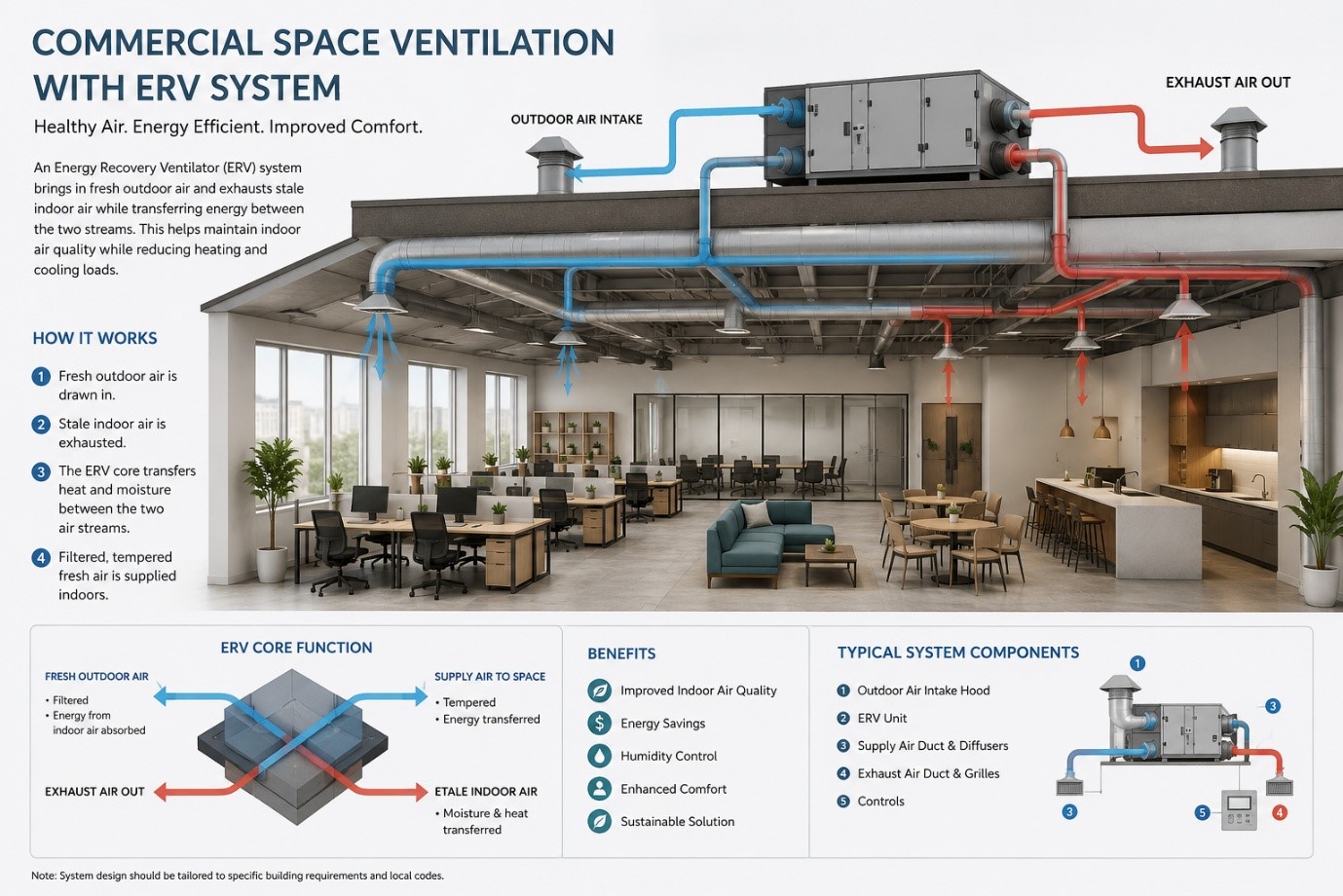
An Energy Recovery Ventilator (ERV) is an advanced ventilation system that supplies fresh outdoor air while recovering energy from the outgoing exhaust air. It helps maintain healthy indoor air quality and significantly reduces cooling and heating energy consumption in commercial and industrial buildings.

An ERV simultaneously exhausts stale indoor air and brings in fresh outdoor air. Inside the ERV core, heat and moisture are transferred between the two air streams without mixing them. This preconditions the incoming air, reducing the load on air conditioning or heating systems.
A Heat Recovery Ventilator (HRV) is a mechanical ventilation system that provides fresh outdoor air while recovering heat from the outgoing stale air. It improves indoor air quality and reduces the energy required for heating or cooling by transferring thermal energy between the exhaust and fresh air streams.

The HRV system simultaneously exhausts stale indoor air and brings in fresh outdoor air. Inside the heat recovery core, heat from the outgoing air is transferred to the incoming fresh air during winter, and vice versa during cooling seasons. The two air streams remain separate, ensuring fresh and healthy ventilation.
A Washroom Exhaust Ventilation System is designed to remove odors, humidity, moisture, and stale air from washrooms and restrooms while maintaining a fresh, hygienic, and comfortable indoor environment. It helps prevent condensation, mold growth, and poor air quality in commercial, industrial, and residential buildings.

The exhaust fan draws contaminated air from the washroom and discharges it outdoors through ducting. This creates negative pressure, allowing fresh air to enter through door gaps, transfer grilles, or fresh air systems, ensuring continuous air exchange.
Click on the Google Review icon and share your thought about us.